Leave Your Message

7 Bedside Runner Carpet Buying Tips for Global Buyers

A bedside runner can make a bedroom feel warmer, quieter, and more finished. It can also become an awkward purchase if its size, materials, or backing do not suit the room. For global buyers, choosing a Bedside Runner Carpet involves more than matching a color to a photograph. Product details, sample quality, packing, and delivery all affect the final result.

Measure the clear floor space beside the bed, including door swings and nearby furniture. A runner that looks generous online may feel narrow beside a wide bed. Check the listed dimensions and ask whether they refer to the finished carpet or an approximate size. Small details matter.

Fiber choice affects feel, care, and expected performance. Wool may feel soft and resilient, while synthetic fibers can offer practical options at different price points. Neither is automatically right for every bedroom. Ask suppliers about pile height, backing, edge finishing, and cleaning guidance, then compare samples under your own lighting. A screen can mislead.

Buyers sourcing across borders should also confirm labeling, packaging, order quantities, lead times, and any market-specific product requirements with their supplier. Request clear specifications in writing, especially when colors or dimensions must match a larger order. A sample helps, but it cannot reveal every issue in production. That deserves a second thought.

The seven tips ahead provide a practical framework for comparing offers and asking better questions. They cannot replace inspection or supplier due diligence, but they can reduce avoidable surprises. A little patience now can prevent a costly mismatch later.
7 Bedside Runner Carpet Buying Tips for Global Buyers

Understanding Bedside Runner Carpets and Their Intended Use

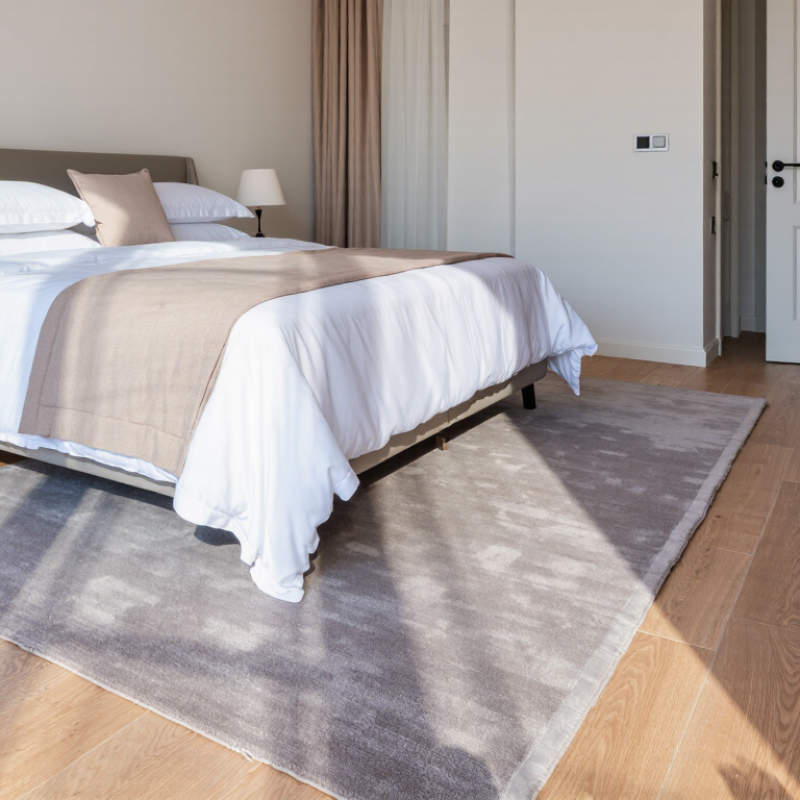
A bedside runner is a narrow rug placed beside the bed, where bare feet usually land. Its job is practical: soften a hard floor, add warmth, and make the first step of the day more comfortable. It is not a substitute for a clear walking path. Measure the space beside the bed, then leave enough room for doors, drawers, and feet to move freely. A runner that bunches under a door is a poor fit, even if its color is perfect.

Safety deserves attention. The World Health Organization’s 2021 falls fact sheet estimates that

37.3 million falls each year are severe enough to require medical attention.

That figure covers many settings, not bedside rugs alone, but it shows why stable placement matters. Look for a firm backing or use a compatible rug pad on smooth flooring. Keep edges flat. Low pile is often easier to walk across and vacuum than a thick, shaggy surface. Still, no rug can make a cluttered route safe. I would check the floor after cleaning, too; damp surfaces can change how securely a runner sits. A small oversight.###

Choosing the Right Size, Shape, and Placement

A bedside runner should extend beyond the area where your feet land, not merely match the bed’s length. Measure the open floor beside the mattress, then check how much space remains when drawers or closet doors swing open. Leave a small gap from the wall so the rug does not bunch or catch dust. A narrow runner can work beside a single bed; wider beds may need one on each side. Measure twice. The bedside table matters, too: a thick rug can make its legs wobble.

Shape affects both comfort and movement. Rectangular runners suit long, straight walkways, while a softly curved edge can ease a tight corner. Choose a low-profile pile if the bedroom door passes over the rug. Test that clearance before buying, using a folded towel to approximate the rug’s thickness. It is an imperfect test, but better than guessing. Position the runner where your feet naturally touch down, with enough length to step onto it after getting out of bed. If the room is asymmetrical, equal spacing may look less natural than a runner aligned with the walking path. Check the layout from the doorway, too. Small shifts can change the whole feel.

7 Bedside Runner Carpet Buying Tips for Global Buyers - Choosing the Right Size, Shape, and Placement

Size recommendations are practical starting points. Measure your bed and available floor space before ordering; mattress and room dimensions vary by market.
Tip Bed and Room Context Suggested Runner Size (W × L) Shape and Placement Buying Check
1. Match the runner to the bed scale Single or twin bed, typically about 90–100 cm (35–39 in) wide 60–70 × 180–240 cm (24–28 × 71–94 in) Rectangular runner alongside the open side of the bed Check that the runner is long enough for comfortable steps out of bed without obstructing a doorway.
2. Allow for wider beds Double or full bed, commonly about 135–150 cm (53–59 in) wide 60–75 × 200–240 cm (24–30 × 79–94 in) One runner on the accessible side, or one on each side if space permits For a pair, confirm both runners fit between the bed and nearby walls or furniture.
3. Choose length for queen and king beds Queen or king bed; mattress widths vary by country and may be roughly 150–200 cm (59–79 in) 70–80 × 240–300 cm (28–31 × 94–118 in) Place lengthwise beside the bed; use a matched pair for a balanced layout Compare the runner length with the mattress length and the clear floor area at both ends.
4. Measure the usable floor space Narrow bedrooms, beds close to a wall, or rooms with built-in storage About 50–65 cm (20–26 in) wide, with length measured to suit the clear area A slim rectangle along the side with the most walking space Measure from the bed edge to the nearest obstruction; leave clearance for drawers and doors to open.
5. Consider shape and furniture layout Rooms with rounded furniture, angled walls, or a soft, layered look Rectangular: 60–80 cm (24–31 in) wide; rounded designs: verify the widest point Rectangles suit straight bed edges; rounded-end runners can soften a compact layout Use the product’s full outline dimensions, not just its central width, when checking fit.
6. Plan placement around traffic and doors Bedrooms with inward-opening doors, bedside tables, or frequent foot traffic Choose a width that stays within the clear walking route; length should not reach into door swing areas Align the runner parallel to the bed and keep edges clear of doorways Mark the proposed outline on the floor with removable tape and test doors and drawers before buying.
7. Check thickness, backing, and floor compatibility Any bedroom, especially one with smooth flooring or a low-clearance door Select the size that fits the layout, then check the runner’s total thickness Place flat beside the bed; use a compatible non-slip rug pad when needed Confirm care instructions, backing suitability for your floor type, and clearance under nearby doors.

Comparing Fibers, Weaves, and Maintenance Requirements

A bedside runner meets bare feet, spilled water, and nightly traffic. Fiber choice affects how it feels and how much care it needs. Wool offers a warm, resilient surface, but moisture and stains need prompt attention. Nylon generally handles repeated foot traffic well; polypropylene resists many water-based stains, though its feel and heat tolerance vary by construction. Feel the pile. I would not treat a fiber label as a maintenance guarantee.

Construction matters just as much. A flatweave is often easier to shake out and vacuum than a deep, dense pile. Low loops can snag on pet claws, while cut pile may show footprints more clearly.

Textile Exchange’s Materials Market Report 2024 estimates polyester made up 57% of global fiber production in 2023. That figure describes the wider textile market, not bedside-rug performance, but it shows why buyers will encounter polyester frequently.

Ask suppliers for pile height, backing composition, and cleaning instructions.

Check whether routine vacuuming suits the weave, and whether the rug can be spot-cleaned without color transfer. The Carpet and Rug Institute recommends following care guidance suited to the specific carpet; a runner’s construction may require different treatment. Test cleaning solutions on a hidden area first. Small caveat: even careful tests can miss later fading.

For humid rooms, compare drying time and backing materials, not just stain claims. A beautiful runner that stays damp is a poor bedside choice.

Checking Safety, Quality, and Regional Standards

A bedside runner should stay flat when someone steps onto it half-awake. The World Health Organization’s 2021 Falls fact sheet estimates 684,000 fatal falls worldwide each year. That figure covers falls generally, not rug-related incidents, but it makes slip resistance worth checking. Ask for tests on the complete runner, including its backing, rather than relying on a “non-slip” label. Small details matter. A curled edge beside a bed can catch a bare toe.

Quality needs evidence beyond a soft hand-feel. Request results for dimensional stability, colorfastness, pile shedding, and backing adhesion, with test methods and sample details. ISO 2551 covers dimensional changes in textile floor coverings; it can help buyers assess whether a runner may distort after cleaning. Still, a test report is only useful when its construction matches the product being shipped. I would check the exact fiber, pile height, and backing stated on the report.

Regional requirements differ. In the United States, CPSC carpet and rug flammability rules apply; buyers should verify the relevant requirements for their product category. For other destinations, request applicable fire-safety and chemical-compliance documentation, such as declarations tied to local rules. Do not assume one certificate covers every market. Keep batch records, too, so a delivered runner can be traced to its test documents.

7 Bedside Runner Carpet Buying Tips for Global Buyers: Checking Safety, Quality, and Regional Standards

Typical moisture regain of common carpet fibers

Moisture regain is the moisture a fiber holds as a percentage of its dry mass. These approximate reference values illustrate a material property—not a safety rating or universal product specification. For a bedside runner, confirm the applicable local requirements for flammability, slip resistance, labeling, and chemical emissions with the supplier.

Evaluating Suppliers, Shipping, and Total Purchase Costs

A bedside runner looks simple, but supplier details can change its comfort and cost. Ask for the fiber composition, pile height, backing material, and edge-finish method in writing. A sample should match the quoted production specification, not just look similar. Check whether the surface sheds when rubbed and whether the backing curls on a smooth floor. Small details matter. One easy mistake is judging color under bright showroom lights; view the sample beside a bed in ordinary room lighting.

Compare suppliers by more than unit price. Request clear information on minimum order quantities, production time, inspection options, and packaging dimensions. Ask how defects are recorded and handled, and keep the reply with your order documents. Shipping quotes should identify the transport method, included services, and who arranges each stage. A low freight estimate can change when cartons are larger than expected. Confirm the estimated dispatch and arrival windows, while allowing room for delays.

Calculate the total purchase cost per runner, including product price, sample fees, packaging, freight, insurance if selected, and applicable import charges. Compare quotes using the same quantity and delivery assumptions. A simple spreadsheet helps, though it can still miss costs that were never disclosed. Ask suppliers to flag exclusions before payment. Also check whether individual runners arrive folded or rolled; deep creases may take time to settle, and that can matter when rooms are being prepared on a tight schedule.