- Home
- About Us
- Products
- News
- Blog
- Contact Us
Leave Your Message
Choosing the best Carpet For Washroom in 2026 starts with one unglamorous question: how wet does the floor actually get? A soft rug beside the sink faces different demands from flooring beside a frequently used shower. Water, soap, and bare feet make grip, drying time, and cleaning routine more important than plushness alone. Small details matter. Check the backing, edges, and care label before buying.
The CDC report “Nonfatal Bathroom Injuries Among Persons Aged 15 Years and Older—United States, 2008” estimated 234,094 emergency-department-treated bathroom injuries; about 81% involved falls. The study does not prove that a particular mat prevents falls. It does show why a washroom floor covering deserves practical scrutiny. Joe Yarbrough, president of the Carpet and Rug Institute, represents the carpet industry’s performance-focused perspective. Applied here, the takeaway is simple: choose for the room’s demands, not appearance alone.
This guide compares washable fibers, low-pile textures, non-slip backing, and moisture management. Look for a mat that lies flat, dries readily, and can be cleaned as directed. If the backing slips on your tile, the product may be wrong for your room, even if its label sounds reassuring. There is no perfect option. Regular laundering and prompt drying still matter. A little less softness may be the wiser choice.
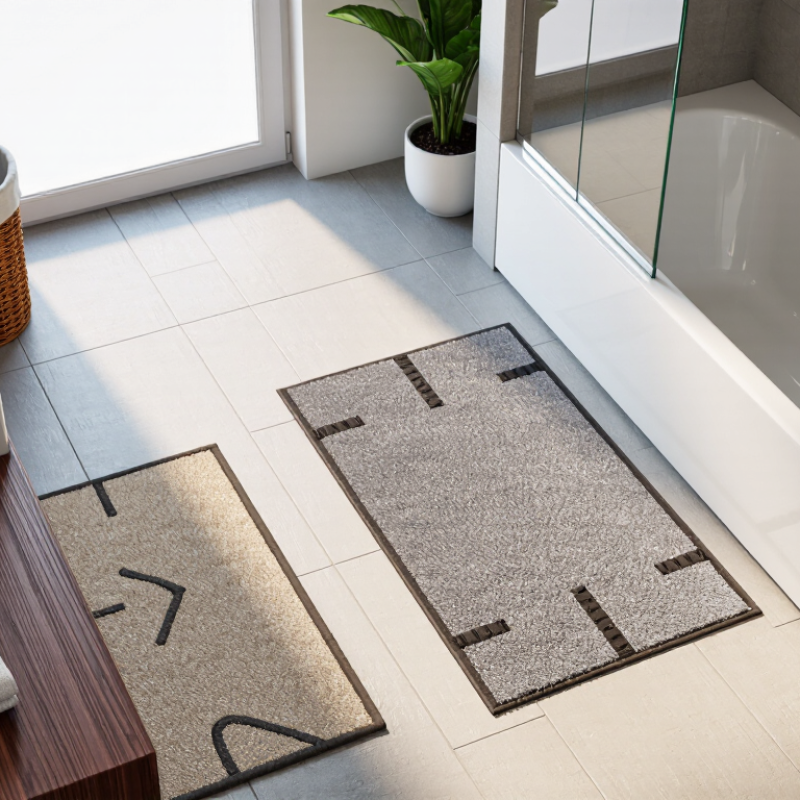
A washroom’s moisture level should guide your carpet choice more than its color. A room with a frequently used shower needs a quick-drying, washable mat with a low pile. Thick, plush fibers can hold water and take longer to dry. Check the care label for washing and drying instructions. Water travels. A mat near the sink may still get splashed from the shower.
Measure the floor before shopping, including the space around doors and fixtures. A large rug can bunch against a door or block a cabinet, while a small one may miss the wettest area. In a narrow washroom, a slim runner may fit better than a broad mat. Keep edges flat, and choose a backing suited to your floor type. That detail is easy to overlook.
Think about daily use, not just the room’s appearance. A family washroom may need frequent washing, while a guest washroom may stay dry for days. Check that the mat can be lifted and dried easily, and follow its care instructions to limit lingering dampness. It is tempting to choose the softest option, but softness is not always practical. Consider where wet feet land, and adjust the placement after a few days of use.
| Washroom Condition | Suitable Material or Style | Moisture and Drying | Layout and Placement | Daily Care | Practical Suitability |
|---|---|---|---|---|---|
| Small washroom with occasional splashes | Machine-washable cotton bath mat | Absorbs water well; may take longer to dry when thick or left on the floor. | Choose a compact size that sits flat in front of the sink or shower without blocking the door. | Check the care label; wash regularly and hang to dry completely between uses. | A comfortable choice when the mat can be dried often and the floor has time to air out. |
| Frequently used shower or bath | Low-pile microfiber bath mat | Absorbs water and is generally quicker to dry than a thick, plush mat, though drying depends on room ventilation. | Place just outside the shower or tub, where it catches drips without remaining under a swinging door. | Follow washing instructions and lift the mat after use to let both sides dry. | A practical option for regular use if it is laundered and dried frequently. |
| Busy shared washroom with repeated foot traffic | Low-pile, washable synthetic bath mat | Usually easier to maintain than a deep-pile rug; water retention varies by construction and backing. | Use a shape and size that leaves a clear path and does not create a raised trip edge. | Wash as directed, remove hair and debris, and check the backing for wear or peeling. | Well suited to frequent use when the mat stays flat and can be cleaned routinely. |
| Washroom with limited ventilation | Thin, quick-drying mat or no textile mat | Any absorbent textile can remain damp longer in a poorly ventilated room; thinner mats are easier to lift and dry. | Keep the floor area open and avoid leaving a mat beside a persistent leak or standing water. | Hang the mat to dry after use; improve airflow where possible and inspect the floor beneath it. | Choose only if the mat can be dried fully between uses; otherwise, leave the area uncovered. |
| Washroom with a smooth tile floor | Washable mat with a floor-compatible non-slip backing | The backing does not make a mat waterproof; the top still needs to dry after absorbing water. | Confirm that the mat lies flat and does not slide on the specific floor surface. | Keep the underside clean and dry; check the flooring and backing for discoloration or residue. | Useful where slip resistance is needed, provided the backing is compatible with the floor finish. |
| Washroom with natural stone or sensitive flooring | Unbacked washable mat, or a mat specifically approved for the floor | Trapped moisture and some rubber or latex backings may affect certain floor finishes. | Use a mat that can be lifted easily so the floor beneath it can be inspected and dried. | Check the flooring and mat-care guidance; do not leave a damp mat in place for extended periods. | Choose cautiously and verify material compatibility before use. |
| Whole-room floor covering | Hard, water-resistant flooring with removable bath mats where needed | Wall-to-wall carpet can hold moisture and is difficult to dry thoroughly after spills or leaks. | Keep removable mats limited to splash zones rather than covering the entire floor. | Address spills promptly and keep mats removable for cleaning and floor inspection. | Generally avoid installing conventional wall-to-wall carpet in a washroom. |